
WELCOME BONUS 300%
UP TO €2000 + 100
FREE SPINS
Home → Blackjack
Blackjack at Jolly Sweeps Casino: Variants, Rules and Payouts
Splitting Eights vs Standing on 16
A pair of eights totals 16, and the rule effect for doubling after a split improves RTP by about 0.14 percentage points. Standing on 16 leaves the player with no additional stake, whereas splitting creates up to four hands with a new double-down option on each. This is a strategic difference in stake exposure, not merely a card value.
The house edge for a liberal Vegas Strip rule set is 0.28%, which already includes resplitting and doubling after a split. Against that, the effect of resplitting aces alone improves RTP by 0.08 percentage points, and doubling after a split adds about 0.14 percentage points. Splitting eights therefore accesses rule modifiers that a standing 16 never reaches.
A six-deck game with S17, DAS and a 3:2 payout carries a house edge of 0.46%, and reaching that figure requires basic strategy. If a player stands on 16 instead of splitting, the theoretical return drifts away from that 99.54% RTP. The cost appears over many rounds, not in one hand.
Clicked Too Late? The Hand Stands Automatically
When a decision is not confirmed before the timer ends, the software holds the hand without an additional wager. This affects any double-down or split opportunity, including a double-down that requires a stake of exactly twice the original bet. The main bet stays in play, but the rule-dependent edge is lost.
A dealer hitting soft 17 changes the house edge by +0.22 percentage points, while late surrender improves RTP by 0.08 percentage points. If the hand is automatically held, the player cannot use late surrender or a double-down, so those rule effects become unavailable. The result is a decision sequence that matches the least favourable option available.
On a €10 main bet, a blackjack at 3:2 pays €15, whereas at 6:5 it pays only €12. An automatically held hand cannot produce that 3:2 outcome because the player loses control of the action. The difference of €3 per blackjack is a direct stake consequence of missing the click window.
Early Surrender Is Gone From Many Tables
Early surrender lets a player fold a hand before the dealer checks for blackjack and take back half the stake. Late surrender, by contrast, is offered only after that check. The difference in value is large: early surrender is worth up to 0.6 percentage points of house edge, while late surrender improves the return by about 0.08 percentage points.
In the liberal Vegas Strip blackjack rule set, late surrender is part of the package alongside S17, DAS and resplitting, and the game returns 99.72% with a house edge of 0.28%. That edge is 0.18 percentage points lower than the 0.46% of a 6-deck S17 DAS DOA game without surrender. The surrender rule alone accounts for 0.08 percentage points of that gap.
A player who folds a 100 € hand under late surrender gets 50 € back, so the loss is capped at half the stake. On a 10 € bet the returned amount is 5 €. Players hunting early surrender will rarely find it, and the practical substitute is a table that at least offers late surrender next to a 3:2 blackjack payout.
16 vs 10 played incorrectly: most common error
A dealer hitting soft 17 lowers RTP by 0.22 percentage points, and this rule interacts with how a hard 16 against a dealer ten is played. The six-deck S17 game has a house edge of 0.46%, and basic strategy is required to reach that 99.54% RTP. A misplayed 16 is one of the most direct ways to give away that edge.
Splitting eights instead of standing on 16 accesses the DAS improvement of about 0.14 percentage points. If the player treats 16 as a single hand and stands, the split option is never available. The rule effect of DAS therefore remains unused, and the theoretical return on that hand stays below the optimal line.
The 6:5 payout change adds +1.39 percentage points to the house edge, which is larger than any other single rule change in the comparison. A player who also misplays 16 against a 10 adds a further strategic loss on top of that payout penalty. On a €10 bet, the 6:5 blackjack pays €12 instead of €15, and the misplay costs additional expectation.
Which Rule Variants the Software Shows
The software shows a single-deck classic game with a 3:2 payout at 99.85% RTP and a house edge of 0.15%. It also shows a six-deck S17 game with DAS and DOA at 99.54% RTP and a 0.46% edge. Both figures assume basic strategy, and the single-deck edge is about 0.48 percentage points lower than an eight-deck comparison.
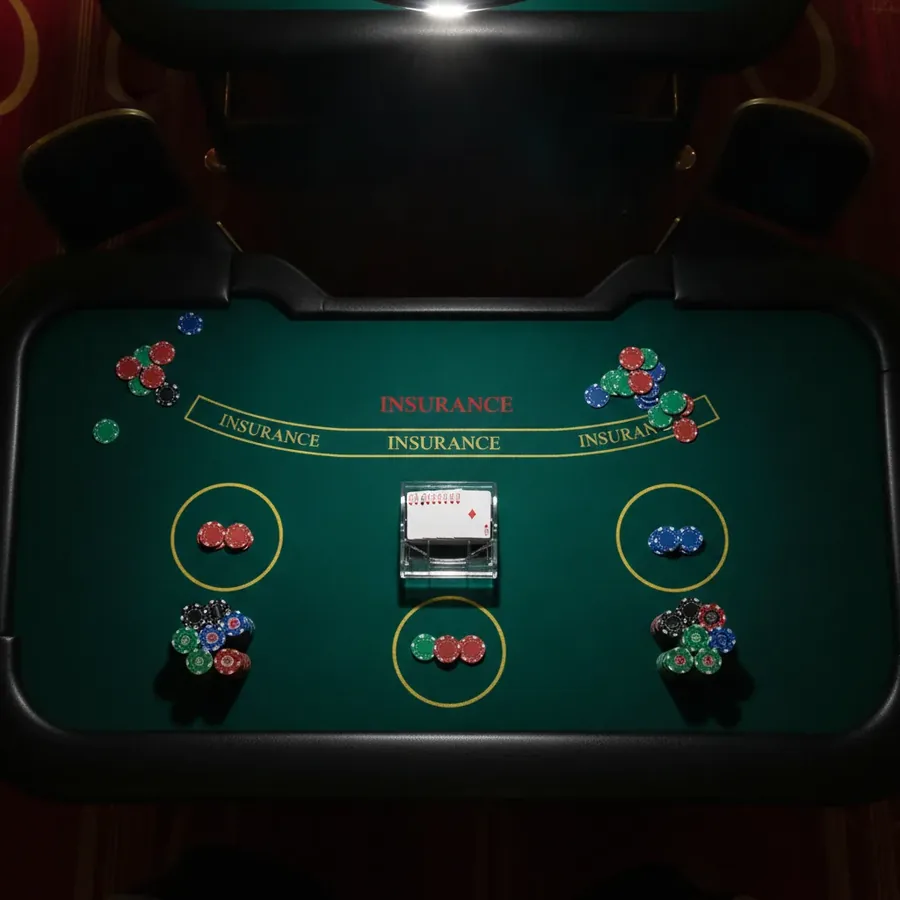
Insurance is shown as a separate side bet of up to 50% of the main bet and pays 2:1. The insurance RTP is 92.53%, equal to a house edge of 7.47%, and basic strategy always declines it. Card counters may accept only at a true count of +3 or higher, where the edge shifts in their favour.
The 6:5 payout variant is present and carries an RTP of 98.15%, with a house edge of 1.85%. Replacing 3:2 with 6:5 adds exactly +1.39 percentage points to the casino's edge. A €10 blackjack pays €12 under 6:5 instead of €15 under 3:2, making this the most expensive rule variant shown in the comparison.
Blackjack variants at a glance
| Variant | Payout | House edge | Rule | RTP |
|---|---|---|---|---|
| Blackjack Insurance (6–8 decks) | Insurance 2:1 | 7.47% | Separate side bet of up to 50% of the main bet when the dealer shows an ace. Basic strategy ALWAYS declines it (except for card counters at a true count ≥ +3). With a single deck the edge is ≈ 5.88% | 92.53% |
| Blackjack Surrender (late surrender) – rule effect | 50% of the stake returned | −0.08 percentage points | The player gives up the hand after the dealer has checked for blackjack and loses half the stake. Improves RTP by about 0.08 percentage points. Early surrender is worth much more (up to −0.6 percentage points) but is extremely rare. | n/a (rule modifier) |
| Blackjack Liberal Vegas Strip (liberal rules, 3:2) | Blackjack 3:2, win 1:1 | 0.28% | The most player-friendly rule set: S17 + DAS + resplit + late surrender. Standard deviation 1.15 | 99.72% |
| Blackjack 6:5 payout instead of 3:2 (6 decks) | Blackjack 6:5, win 1:1 | 1.85% | Replacing 3:2 with 6:5 adds exactly +1.39 percentage points to the casino's edge – more than any other rule change. On a €10 bet a blackjack pays €12 instead of €15. | 98.15% |
| Blackjack Split / double / H17 – rule effects | Double – stake ×2 with one card; split – up to 4 hands; split aces usually get one card each. | H17 +0.22 percentage points; RSA −0.08 percentage points; DAS −0.14 percentage points | Dealer hitting soft 17 lowers RTP by 0.22 percentage points; resplitting aces improves it by 0.08 percentage points; doubling after a split improves it by about 0.14 percentage points; 6 decks instead of 8 – about 0.02 percentage points. | n/a (rule modifiers) |
| Blackjack Single deck, classic rules, 3:2 | Blackjack 3:2, win 1:1 | 0.15% | Fewer decks = lower edge; one deck gives about −0.48 percentage points compared with 8 decks. Often offset by a 6:5 payout. | 99.85% |
Continuous Shuffling Machines Reshuffle After Every Round
A continuous shuffling machine returns discards to the shoe and shuffles after every round. In Blackjack 6 decks, S17, DAS, DOA, the dealer stands on soft 17, double down is allowed on any first two cards, and doubling after a split is permitted. The required basic strategy yields an RTP of 99.54% and a house edge of 0.46%.
Continuous shuffling removes the cut-card penetration effect described for a shoe with 75 percent penetration. Card counting at a true count of +3 or higher is the only case where basic strategy deviates on insurance. With continuous shuffling, the count resets each round, so that exception effectively disappears. The standard deviation for the Liberal Vegas Strip rule set is 1.15, but that figure belongs to a shoe-dealt game.
The rule modifiers show how individual changes move the edge. Dealer hitting soft 17 adds +0.22 percentage points, while doubling after a split improves RTP by about 0.14 percentage points. Resplitting aces improves it by 0.08 percentage points. Six decks instead of eight account for about 0.02 percentage points. Continuous shuffling itself is not assigned a separate modifier in the rule-effect table, but it prevents penetration-based play.
The Shoe, the Cut Card and 75% Penetration
A shoe-dealt game with a cut card determines the point at which the dealer stops and reshuffles. With 75 percent penetration, three quarters of the cards are dealt before the shuffle. The single-deck classic rules game with a 3:2 payout reaches an RTP of 99.85% and a house edge of 0.15%. Fewer decks produce a lower edge.
One deck gives about −0.48 percentage points compared with eight decks. The Liberal Vegas Strip rules combine S17, DAS, resplit and late surrender for an RTP of 99.72% and a house edge of 0.28%. The standard six-deck game with S17, DAS, DOA and 3:2 pays 150 EUR on a 100 EUR stake and holds a 0.46% edge. Penetration depth changes how often the cut card stops play, not the RTP of the basic strategy itself.
Late surrender in Blackjack Surrender returns 50% of the stake and improves RTP by about 0.08 percentage points. Early surrender is worth up to −0.6 percentage points but is extremely rare. Split doubles allow stake ×2 with one card, and split aces usually receive one card each. A shoe with 75% penetration leaves 25% of the cards behind the cut card, which is the unplayed tail.
When Can You Raise Your Bet?
Doubling down is the primary rule that lets a player increase a bet after the initial two cards. Blackjack 6 decks, S17, DAS, DOA allows a double down on any first two cards, with the stake multiplied by two and exactly one additional card dealt. The resulting RTP of 99.54% assumes basic strategy is used for every doubling decision. A 3:2 blackjack pays 150 EUR on a 100 EUR stake.
Doubling after a split is permitted in the same six-deck variant and is worth about 0.14 percentage points in RTP. Splitting itself allows up to four hands, and split aces usually receive one card each. Resplitting aces improves RTP by 0.08 percentage points. The split rule means a player can increase total exposure beyond the original stake when the first two cards form a pair.
The house edge changes with rule modifiers, so the decision to increase a bet depends on the exact table. Hitting soft 17 costs 0.22 percentage points, late surrender returns 0.08 percentage points, and doubling after a split returns about 0.14 percentage points. At Lightning Blackjack from Evolution, the bet range runs from 1 EUR to 2,500 EUR. Quantum Blackjack Plus Live from Playtech accepts 1 EUR to 5,000 EUR.
How many decks are in the shoe?
The standard blackjack variant is played with six decks. Blackjack 6 decks, S17, DAS, DOA with a 3:2 payout and basic strategy has an RTP of 99.54% and a house edge of 0.46%. The dealer stands on soft 17, double down is allowed on any first two cards, and doubling after a split is permitted. Surrender is not part of that rule set.
A single-deck game with classic rules and a 3:2 payout reaches an RTP of 99.85% and a house edge of 0.15%. The figure is often offset by a 6:5 payout, which adds exactly +1.39 percentage points to the house edge. A €10 blackjack at 6:5 pays €12 instead of €15.
Insurance in a six-to-eight-deck game has an RTP of 92.53% and a house edge of 7.47%. The side bet of up to 50% of the main bet pays 2:1 when the dealer shows an ace. Basic strategy always declines it except for card counters at a true count of at least +3. Six decks instead of eight lower the edge by about 0.02 percentage points.
The 3:2 Blackjack Payout Explained
Blackjack Liberal Vegas Strip pays a natural at 3:2, which turns a win of 100 EUR into 150 EUR, not 100 EUR. The listed RTP for this variant is 99.72%, leaving a house edge of 0.28% under dealer stands on soft 17, double after split, resplit and late surrender. On 100 EUR staked, the expected loss is only 0.28 EUR over the long run.
The contrast with a 6:5 payout on six decks is 1.85% house edge against 0.46% for a standard six-deck game with a 3:2 payout. A natural on 100 EUR pays 120 EUR at 6:5 instead of 150 EUR at 3:2, a shortfall of 30 EUR per blackjack. Replacing 3:2 with 6:5 adds exactly 1.39 percentage points to the casino edge.
Quantum Blackjack Plus Live from Playtech reports 99.57% RTP with optimal strategy, while Lightning Blackjack by Evolution sits at 99.56%. Both live tables keep the classic 3:2 payout on a natural, with bet ranges of 1 – 5,000 EUR at Playtech and 1 – 2,500 EUR at Evolution. A 100 EUR stake returns 150 EUR on a blackjack at either table.
Split Aces: Only One Card per Hand
Splitting aces usually grants one card per hand, so a player cannot double after splitting aces. Resplitting aces improves RTP by 0.08 percentage points when allowed. Blackjack Liberal Vegas Strip notes resplit as part of its rule set, with an RTP of 99.72% and a house edge of 0.28%.
Doubling after a split improves RTP by about 0.14 percentage points, but that option does not apply to split aces receiving a single card. The standard split rule permits up to four hands, while split aces get one card each. On a 10 EUR split, each new hand receives only one additional card, capping the total stake at the table minimum times the number of hands.
The six-deck game with dealer stands on soft 17, double on any first two cards and double after split allowed lists a house edge of 0.46%. Dealer hitting soft 17 adds 0.22 percentage points, while six decks instead of eight improves the edge by about 0.02 percentage points. These rule modifiers accumulate around the split and double restrictions.
Insurance vs Even Money When You Hold Blackjack
Insurance pays 2:1 when the dealer holds a blackjack after showing an ace, but its RTP is only 92.53% on six to eight decks. A player with a natural can take even money for a guaranteed 1:1 win instead of risking a push. That even money offer is mathematically identical to taking insurance, and basic strategy declines both in almost all cases.
The single-deck insurance edge of roughly 5.88% compares with an 8-deck difference of about −0.48 percentage points for the main game. On a 100 EUR blackjack, even money immediately pays 100 EUR, while a 3:2 payout pays 150 EUR unless the dealer also has blackjack. The long-run cost of insurance is 7.47 EUR per 100 EUR wagered on six to eight decks.
Blackjack Liberal Vegas Strip carries a 3:2 payout and a 0.28% house edge, so the natural itself is not threatened by an even-money take. The separate insurance bet of up to 50% of the main wager adds a 7.47% house edge on top. Card counters accept insurance only at a true count of +3 or greater, where the remaining deck composition shifts the edge.
Soft vs Hard Hands in Practice
A soft hand contains an ace counted as 11, while a hard hand either has no ace or an ace forced to count as 1. Dealer hitting soft 17 raises the house edge by 0.22 percentage points, turning a stand-on-soft-17 game of 0.46% into 0.68%. Blackjack Liberal Vegas Strip uses dealer stands on soft 17, holding the edge at 0.28%.
Doubling on any first two cards, including soft totals, is allowed in the six-deck game at 99.54% RTP with a 0.46% house edge. A player holding ace-six for soft 17 can double against a weak dealer card, while a hard 17 normally stands. That flexibility is part of basic strategy and required to reach the listed 99.54% return.
Resplitting aces improves RTP by 0.08 percentage points, and doubling after a split adds about 0.14 percentage points. A split ace receives only one card, so a soft hand after splitting aces cannot be doubled. On a 100 EUR stake at Blackjack Liberal Vegas Strip, the expected loss is 0.28 EUR, reflecting all these rule effects together.
Contact
Live - online chat
Banking









Providers












Jolly Sweeps Casino 2026